Sunday, February 15, 2009

A Few Articles For Your Sunday

It seems like a while since I last did a roundup of Sunday Morning paper reading.

First up, the master of the Olde Timey-ness - M. Ward

Second, far less painful than reading one of his books, an upbeat column from Thomas Friedman on green energy

And in the WaPost a little reminder of the effects of the recession from those hardest hit.

Also, another green article, this one a bit more realistic and a bit more glib, but hey that's the Post for ya, right?

Thursday, February 12, 2009

How To Drive in Four Easy Steps

Beyond the basics of stopping, going and being observant of the world around you there are, to my mind, really only four things you need to do when you are driving to make your life and those around you safer and better.

1. When you are turning use your turn signal. 2. When you need to get someone's attention, honk. These two go hand in hand and are the only two legal, available ways for you to communicate with other vehicles and pedestrians (the middle finger is for emergencies only). If you are driving in front of me and you slow down for no reason I have to infer what the hell you are doing. Are you turning, is there are pothole, did you drop your cell phone on which you shouldn't be talking? If you use your turn signal then that makes it clear, and if I honk, I am conveying that I do not know what you are doing. I wish there were multiple horn sounds on a car, but there aren't, so if you need to convey any urgent information that doesn't involve turning, you're most likely going to have to honk.

3. When in doubt, use your headlights. With very few exceptions there is no harm and only benefit in using your headlights. This seems common sense, but then you see a car in the pouring rain without any headlights and you start to wonder about people.

4. Drive so that you don't have to break as often. This is especially important in this land of congestion. Excessive breaking has been proven in studies to (a) waste gas and (b) make traffic jams worse. There is nothing worse you can do for yourself or those around you then tailgating someone in a traffic jam. So it follows, that when traffic is heavy the more space you give cars the less you have to break and the more traffic moves. Those of us with stick shifts have the advantage that we can down-shift, but even if you drive an automatic, you can TAKE YOUR FOOT OFF THE ACCELERATOR FIRST, then if things are really stopped in front of you, brake.

I don't claim to be the worlds best driver, but if everyone did these things, the world would quite literally be a better place.

One Year in Four Colors - Captain Atom: Armageddon

So I've decided to write a review or analysis of every Graphic Novel I read in 2009. I'd try for every comic, but none of us have that kind of time.
*Spoiler Warning* should be considered general practice.


Captain Atom: Armageddon

Writer: Will Pfeifer
Artists: Giuseppe Camuncoli & Sandra Hope
Publisher: DC/Wildstorm

Captain Atom: Armageddon is one of those weird beasts you only find in the world of comic books and collected editions, given how many masters this book is attempting to serve. This book acts in many ways as connective tissue - a transitionary story to move people and places into the appropriate spots for their next appearance and major events that are lined up. What makes this particular book stand out is that it is attempting to do that with two entirely separate super-hero universes and publishing plans. In order to function properly, this book has to tell it's own fulfilling story from beginning to end - but also take Captain Atom of the DC Universe from where we last saw him and lead him to where he's going, but also leave the Wildstorm universe in an entirely new place.

The plot of the story is about Captain Atom mysteriously arriving in the Wildstorm Universe with no way to get home. He soon discovers that the nature of his trip has led to something gone wrong inside him and unless he returns home immediately, his very presence on this alternate Earth will lead the the absolute destruction of this Universe.

Captain Atom is a DC hero, who originally started as a Charlton hero. In the '60s, Charlton was it's own comic book company - publishing characters like The Question and Blue beetle. Eventually they went out of business, and during the 1980s DC bought the rights to their characters and during the landmark Crisis on Infinite Earths integrated those heroes into their line - the conceit being that they had been a part of their history the whole time. The Charlton characters were actually the inspiration for the groundbreaking book Watchmen, and Captain Atom was the direct inspiration for Dr. Manhattan. Since Crisis, Atom has been a part of the DC Universe - acting as both a government operative and member of the Justice League. His backstory is that of Nathaniel Adam - a government agent falsely accused of treason. Rather than rotting away in prison, he chose to undergo an experimental quantum procedure in exchange for his freedom should he survive. Instead, the accident sent him twenty years into the future and imbued him with atomic energy and a quantum shell. Since then, despite being one of the most powerful beings on Earth, he's always felt overshadowed as both a hero and a man by people like Superman - never attaining A-list status.

The Wildstorm Universe began as one of the founding studios of Image Comics. In the '90s, a group of extremely dissatisfied and extraordinarally popular Marvel artists banded togather to form their own company based around creator rights. It was a shot heard round the industry - and one of those artists was Jim Lee, famous for his work on the X-men. A loose collection of individual studios, his was called Wildstorm and became it's own self contained super hero universe including title like WildC.A.T.S., Deathblow, and Gen13. Eventually Lee sold Wildstorm to DC comics, remaining it's Executive Editor, and Wildstorm became a separate publishing arm of DC (like Vertigo, CMX, or the now defunct Minx line). Along the way Wildsorm became known for darker, more morally ambiguous heroes with a sci-fi edge - leading to books like The Authority, Sleeper, and Planetary.

After a huge boom in the early 2000s, the Wildstorm Universe had sort of cooled off, and a revamp was planned. Across the continuity stream, DC was gearing up for it's Crisis sequel, Infinite Crisis. And so Captain Atom: Armageddon was born - to help draw attention to the Wildstorm reboot by including a DC character in the lead up, as well as to set up Atom for his next story beat in Infinite Crisis. The story started with Atom's last appearance in Superman/Batman: Public Enemies when he appeared to sacrifice his life to save the Earth piloting a giant rocketship into a Kryptonite meteor, and attempts to address some lingering continuity errors from that title.

But aside from all the publishing concerns, this is a story unto itself. And what really drives this story is the difference between the DC and Wildstorm Universes using Atom as a viewpoint, and a man just trying to get home. And in that, the story does a wonderful job. Captain Atom is portrayed as an honorable hero - always looking to avoid confrontation in the name of sanity and discussion, his attempts constantly being thwarted by an entire world of metahumans who hit first and MAYBE ask questions after the funeral. His horror at seeing an entire people subjugated by fear is palpable, his anger at seeing the human race cowering under the bootheel of morally ambiguous super-powered 'heroes' is justified. This book shows Captain Atom as the best kind of hero, and a good man - who despite constantly feeling lessened in his shadow still says "Thank God - Superman" when he sees a flying man in a cape coming towards him. This book really invigorates Atom as a character - and does a good job of showing why the Wildstorm Universe deserved a Noah like flood at the end to wipe away their sins.

So what makes this book harder to enjoy in hindsight is the knowledge of what came after, and how much potential was squandered. Instead of capitalising on this book with a Captain Atom arc that finally saw him become the hero in the DCU that he always had the potential to be, editorial decided to pursue a failed idea from decades back and turn Atom into Monarch, an insane power hungry villain with absolutely no explanation. And the big Wildstorm reboot? Dead in the water after two flagship titles never made it past two issues, and has already gone through another reboot since - DC usually waits twenty years between Crises and Marvel has never had one, so that's bad.

This was a fun story that made me love Nathaniel Adam a little bit more, and it's reccomended if you want to see what makes this character so cool - this is Captain Atom at his absolute best. But for the novice comic book reader, not the best starting point.

Wednesday, February 11, 2009

The Sound of Settling

I'm starting to go grey.

I don't think it's going to be any day now, and I'm not sure if anyone who sees me on the street (or even often) would notice yet - and if they do, no one's made a crack or joke so far. But slowly and surely it's happening.

And I'm thinking a lot about it.

I was doing my hair in the mirror for Proof a few weeks back and I noticed this one long white strand dead center in my spit-curl, staring at me from the mirror. I've had grey hairs before - it was a favored game of my ex to find them in my head and pull them out, so I've known that they're there. But this was different. It felt different. It was stark, white, and up front in a way that could not be ignored.

Yesterday I started looking through a mirror and found a lot more. And today in the shower I started to really think about why it was bothering me so much. And not in any kind of prominent or intense way, nothing painful or anxious, no freak out, just a bother - like a small hangnail that I'll subconciously play with even though I know I shouldn't until it starts to hurt.

I don't want to go grey.
I don't want to get any older right now. I don't want to become any less attractive.
I don't want to settle.

Tough luck, right?
I mean obviously, not many people do.

I just wish it weren't the hair, y'know?

I care a lot about my hair. It's one of those things where I don't always have a lot about my physical appearance that I can usually point to with a great deal of pride. And that's too bad, cause I doubt that has as much to do with the reality of how I look so much as it has to do with my own warped perceptions. But even with all that self-defeating internal rhetoric I have playing out on a daily basis, I know one thing - I've got nice hair. Really nice hair. Thick, bouncy, soft, curly, full - all those stereotypical words you may hear in an overzealous shampoo commercial also happen to fit my flowing locks. The kind you just wanna play with. I know I do.
I really don't want to lose this one thing that even on the worst feeling days I can sort of pull out and use as a turbo boost of self esteem.

But more importantly than any kind of vanity or self-conciousness, I've discovered that that hair is a real pronounced part of my self-identity. Ever since New Mexico, when I grew my hair down to my shoulders and finally had that long hair I always wanted, this sort of shaggy would be rock star look has become a part of my mental picture. Driving down the highway on a sunny day, blasting loud catchy melodies with the window down, hair swirling in the pressure vortex of my elantra, or carolla, or one day convertible - I'm happy. Few things get me so quickly to that ever elusive far off state of happy. This is how I see myself. I'm 23 - I don't feel like letting that go.

I don't really want to deal with getting older. There's a lot I feel like I've missed out on, opportunities I wasted, chances I didn't take - hours refreshing the same webpage waiting for content. I'm in a place now where i feel I'm starting to rectify that, inch by inch, choice by choice.
But it's hard to keep that momentum going when it feels like there is a ticking clock waiting on top of my head, letting me know there's only so long before I'll have to look in the mirror and evaluate whether I have more time ahead or behind.

Or maybe I'll just look distinguished...

Video Games and Myth: The Legend of Zelda - Ocarina of Time and Twilight Princess


A chosen hero to beat back the tides of darkness. A courageous knight who rises to rebuild a kingdom. The Legend of Zelda series tells the tales of young Link, a boy literally marked by destiny. Within each story lies ample evidence of myth, from the naming of Link's horse "Epona" (Gaulish word for "Sacred Horse and a Celtic Deity) to Link's recent transformation into a wolf (canines are seen as guardians of the underworld in many cultures). Given the series' title, however, it's not surprising that a great deal of the games' source material would come from popular legends - namely Arthurian Romances. Installments A Link to the Past, The Ocarina of Time, and The Twilight Princess provide strong evidences of the use of these beloved legends.

1. A Sword in the Stone
Perhaps one of the most popular Arthurian tales, the Sword in the Stone tells how Arthur comes to learn of his lineage. A sword only  released by the hand of the one true king. Arthur happens upon the sword almost haphazardly, removing the sword at a whim, taking a significant step toward his destiny of unifying England and purging it of corruption. Whether the sword represents
 Excalibur is a matter of debate, as popular criticism recognizes that the actual Excalibur was given to Arthur by the Lady in the Lake. However, The Legend of Zelda pays homage to either theory by unifying them into a single symbol - The Master Sword.

The Master Sword rests within its own pedestal, awaiting the arrival of the chosen hero to release it from its earthen bond. As the Sword in the Stone, the Master Sword represents a mile-stone in Link's journey towards manhood and guardianship. Like Excalibur, it's Link's primary weapon against evil, being the bane of darkness and the only weapon able to effectively wound primary antagonist Ganondorf (or Ganon, if you prefer). Link obtains the Master Sword at the turning point in his journey - either just before or just after the world is enveloped by darkness. Releasing the Master Sword from its pedestal often serves to reaffirm Link's chosen destiny during this time. And, much like Arthur's Excalibur, Link would never be able to beat back the black without it.

2. The Otherworld
A critical element of the Arthurian Romances is the presence of the Otherworld, a realm at the very edge of our own.  To enter, often times the hero must pass through a forest away from typical human civilization. As one slips deeper and deeper into Otherworld, the natural rules of the universe slowly begin to change. The magic there is very obscure, often resulting in what appears to be psychological tricks or hallucinations, putting the hero at a distinct disadvantage over local residents. The Legend of Zelda employs its own dualistic world in nearly every installment.

Be it the Dark World, the Twilight Realm, or simply a timeline seven years in the future, an Otherworld is just as present here as it is in Arthurian Romance. Although there are plenty of examples, the Ocarina of Time provides some of the strongest evidence. The "Otherworld" 
is featured by a future timeline, accessible only after pulling out the Master Sword from its pedestal. Link is essentially "Rip van Winkled," falling asleep until he's of age to properly use the sword. In the new world, Ganondorf has succeeded in usurping the throne and the kingdom's races are either forced into hiding, captured, or frozen forever. Link's goal is to put the pieces back together, often traveling back to the present to change the grim future ahead. Link is forced to deal with the suddenness of adulthood and the effects of a seven-year tyrannical rule he could potentially prevent. It's notable that at the game's end, Link is sent back before the game's events and Ganondorf is effectively stopped by Zelda (Princess of Hyrule) before the grim future can occur - making the future timeline not just gone, but seemingly illusory, and memorable only to Link and Zelda.

3. Ganon the Boar
Boar imagery is very subtle in Arthurian Romances, but it's there all the same. Boars are often associated with Arthur and his line, particularly to highlight the link between himself and Mordred, who seeks to usurp the throne. Malory highlights this particular concept when Mordred is speared by Arthur, but continues to charge forward in a boar-like rage, killing him. This element manifests in Ganon's appearance on the right. 

Designers have historically presented Ganondorf as a powerful wizard interested in usurping the throne and bending the world to his will. Immediately, one should think about Mordred and his sinister aspirations. However, Lancelot's King Maleagant (a King in the Otherworld) seems present as well. Note Ganondorf's affinity for magic and kidnapping Princess Zelda - both common motifs repeated in Arthurian Romance with Maleagant's abduction of Guinevere. Conjoined with his transformation into the boar "Ganon" at endgame (often right before he dies), players can easily conclude that Ganondorf represents another artful fusion of Arthurian motifs. This assertion can be immediately strenghtened by the fact that Maleagant's influence in the legends diminshes as Mordred became a more prominent character. Conveniently, this draws the inevitable comparison between Link and Lancelot, as opposed to Arthur.

4. Link du Lac (a.k.a. "Link gets Ladies")
Lancelot was first introduced as a primary protagonist in Chrétien de Troyes's Lancelot the Knight in the Cart, depicting the valiant knight's attempt to rescue Queen Guinevere from Otherworld-King Maleagant's abduction. The famous romance begins during this story, as Lancelot charges head first in pursuit of the object of his courtly affections. What's noteable about Lancelot are his origins (he's originally from the Otherworld), his representation as the (near comic) epitome of chivalric love, and that Lancelot is told in installments of each maiden he's come across on his journey. Link's adventures share some striking similarities to Lancelot's tale.
Note that Link's journey begins in the forest within both installments Ocarina of
 Time and Twilight Princess - a place we've already established to denote "otherworldliness." Link leaving the forest for the rest of the world is usually portrayed as a big deal, marking the start of a momentous journey to fulfill a duty of sorts. This is usually followed by some interaction with Princess Zelda which leads to Link somehow becoming her "personal knight." Although the love between Lancelot and Guinevere is often (but not always) explicit, Link and Zelda's relationship remains up to debate. Depending on which tradition of courtly love you're following, this could still fit the model - particularly since romantic undertones between the couple are usually present. However, the strongest evidence comes from the number of "maidens" Link comes across. Above is a picture of most of the women from the Legend of Zelda series, most of whom have a significant role in Ocarina of Time. Not to mention, of course, the main similarity - their apparent sexual attraction to the protagonist. Link, like Lancelot, has to deal with the droves of women who just want a piece. Some comical, some tragic, each marks a necessary spot in their respective hero's journeys.

The final scene in Twilight Princess portrays the most iconic Lancelot reference in the Legend of Zelda series. In Lancelot, our hero is released from a prison by a woman riding an animal (one of my favorite characters in Arthurian Legend) and proceeds on horseback to chase down Maleagant once and for all. Lancelot finds Maleagant in a field and, after a short sword fight, Lancelot decapitates the Evil King with ease and rides away with Guinevere in tow. Although Link isn't released from a prison by a woman per se, he requires feminine aid (i.e. Zelda and her light arrows) to help him chase down and stop Ganondorf in the game's final minutes. In epic stride, Link and Zelda succeed, and Link is forced to fight Ganondorf in an ultimate battle to the death. Ganondorf and Link undergo a sword fight in a field, surrounded by fire, until Link beats him down and stabs him through the heart. Although not a complete copy, the themes are definitely present to recognize Link as a distinct Lancelot reference.

(property of Emmanuel Diaz)

Arthurian Romances are everywhere. Arthur and his representations often arise during times when a nation needs a hero. A leader to help rebuild or a knight to lead by example. Lancelot represented the ultimate knight with a solitary chink in his armor - his reciprocal love for his best friend's wife. A love (at least in Malory's works) heavily implied that Arthur knew about. I'm curious if that will ever be worked into the series. A penitent Link would be, at the very least, interesting and different. Well, Gentle Reader, I hope you enjoyed this epic installment. It'll probably be the last one for a long, long time. As always, feel free to post below.

Tuesday, February 10, 2009

Stuff I Love-Third Edition

BE HERE NOW-SOMETHING I LOVE


Most of my friends don't really like Oasis's third record that much. In fact, most people I talk to don't like Oasis' third record much. "The songs are too long," "they don't seem to be about anything," and "none of the sound like Wonderwall" are some of the more frequent complaints. But to me, this album is the pinnacle of Oasis's brilliance, the height of their musical mastery.

Take, for instance, my personal favorite song on the record, "I Hope, I Think, I Know."


I just love this song. It starts like a shot to the face, and it just doesn't quit. It's vintage Oasis-Liam being loud, obnoxious, and non-conformist, and Noel and the boys backing him up with a sound so full it's hard to even pick out individual instruments at times. It's just the classic Oasis record-it doesn't get any better than this.

Yes, the songs are long, but it just works. No matter how many times the beat vanishes and comes back on "D'ya Know What I Mean," it it hits just as hard every time. And so what if "Around the World" is ten minutes long, it's a killer song, and you get to hear Liam Gallagher say the word "sheeeyyyinnne" a bunch of times. I think that's a pretty strong argument right there.

I guess part of it is also the time period in my life that the record makes me think of, being a kid in the ninth grade and religiously following Oasis's every move. The record showed Oasis heading in a new direction, experimenting with their sound and, at the same time, moving it forward in a way they, in my opinion, have never been able to repeat. This record is why I'm still a fan.

Overheard on Sesame Street


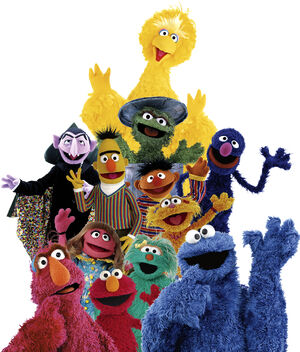
Top to Bottom: Big Bird, the inspiration for "Twilight,", a Dave Chapelle skit, an inept waiter, a gay couple, two interchangeable female monsters, the girl who yells at Cookie Monster, a marketing ploy, a victim of the FCC, and Telly.


I decided to watch Sesame Street while channel surfing this morning, and was greeted by the sight of a large black man standing in a shadowy den. His contribution to the show?

"I love the word gigantic. It means really, really, really, really big. I'd sure love to show you something gigantic."

. . .

So yeah, it turns out this show is actually better when you're older.

Also, the number of the day was 2, and the letter was Q.