Showing posts with label debate. Show all posts

Monday, October 15, 2012

5 Reasons Joe Biden Won the Vice Presidential Debate

On the eve of the second Presidential debate, or Debate 2: Bate Harder, the results of the Vice Presidential confrontation a few days ago are quickly being forgotten. Here at Hofstra, campus is an absolute maze of news cameras and Secret Service, all focused on the two Presidential candidates. In my opinion, now is the perfect time to refresh our memories as to what exactly happened in the last debate, which people seem to be having trouble deciding who won.

Some very reputable and trustworthy news organizations are touting Paul Ryan as the winner. A number of polls indicate that the public considered it to be a tie. I think a lot of people with those viewpoints don't really know what "debate" means. Here's why it's pretty indisputable that Joe Biden scaled Ryan's harrowing widow's peak to become the clear victor.

5) He Was a "Bully"


A number of people keep pointing out that Biden continually interrupted Ryan, acted condescending by laughing, rolling his eyes, and smirking as the VP candidate spoke. The most overwhelming assessment of these actions were that Biden was "a bully."

So what's a bully, exactly?

A bully is what we call someone we see beating up somebody who can't defend themselves.

I do remember Biden stuffing Ryan's shirt with crud.

Neither of the candidates were completely honest up there, though Ryan did perhaps a bit more stretching of the truth than Biden. Joe did what Obama was not willing to do during the first debate - get up and in Ryan's face when he started lying. The most widely held reason people think Obama lost the first debate despite the fact that Romney told 27 lies in 38 minutes is that the President looked like he was floundering out there. His poise, his demeanor, his tone all bespoke a man who didn't want to be where he was. Romney, on the other hand, went on the attack, and no matter what he said, he looked good saying it.

Now the tables are turned. Biden put up a clear message of "I'm not putting up with any of that bullshit," and hammered back at Ryan on every point the Congressman tried to make. If Biden was a bully, it's because he made Paul Ryan look weak and ineffective by comparison. Detractors latched on to his attitude and confrontational demeanor because it's not like they had a lot of ammunition to hit back with otherwise.

Come to think of it though, Ryan does work out a lot.


4) He Looked Like a Human Being

                                                                               Image Credit: Alex Wong/Getty Images
Paul Ryan is given credit for maintaining his composure and appearing dignified while accepting the beating he received. People have been pointing to his steadfast refusal to blink as a sign that he was doing a better job connecting with the audience. Biden's relaxed posture, eye-rolling, and laughing weren't "Vice Presidential," and so Ryan took that battle.

This is why we can't have nice things.

But if you go back and watch the video, you see a lot of Ryan staring ahead, grim-faced, while Biden enacts more or less the same body language Mitt Romney had in the debate he "won." The only difference being that Biden actually threw in some human emotion and reaction.

The people who want to make this argument are trying to have it both ways. If Obama is stoic and professional, he loses against a more animated and aggressive Mitt Romney. When Ryan is exuding the physical responsiveness of a coma patient whenever he's not speaking and Biden presses the assault, he's a bully and Ryan is "Vice Presidential."

Biden looked like a person who couldn't believe what he was being made to argue against. Ryan looked like he was trying to keep every muscle flexed at once throughout the entire hour and a half.


Even - especially - his face muscles.

Monday, March 22, 2010

AntiPro

I've been mulling this over in my head for weeks now, trying to think of the right words, the most sensitive phrasing, the best possible way to approach this subject. But here again, this morning on NPR, I heard it: "We are proponents of health care reform, but there is one subject that trumps all others, and that is the sanctity of life."

Sanctity of life. When the man on the radio said it he was talking about being pro-life, or anti-abortion or however you choose to describe it, but at this point I feel like it has been reduced to a propoganda buzzphrase that just serves to make its opponents sound like a-holes.

And at the risk of giving away my politics, I don't think I am an a-hole. Because I get being anti-abortion, I do. Where life begins is a belief and far be it from me to knock on anyone's beliefs. But. What confuses and frustrates me is when I hear that that it is the single most important politic in a person's repertoire. Because, if sanctity of life is truly your number one concern, shouldn't your top politic be adoption and foster care reform, or help for the homeless, or bigger budgets for rehabs and crime prevention? What about budgets for rape counseling at schools, abolition of death row, child-care and CPS reform, welfare reform, harsher penalties for dead-beat parents, or proper sex education?

Are people only important when they are half-made?

Because that doesn't seem fair to all the people who have been born and are trying to make it in our harsh, overcrowded world. And I don't think committing murder (see: Scott Roeder) is the way to show people how compassionate you are about all the unborn babies that are just as likely to become abortion doctors or homeless addicts as christian evangelists.

It is important for women to know and understand what their other options are, if for no other reason than that abortion can be extremely taxing for a woman on an emotional, physical, and spiritual level, but as it stands there aren't many because the money and support simply are not there.

So when people say shutting down abortion clinics is their number one concern, I can't help but feel frustrated and helpless, and like we are only pulling an unsightly band aid off a broken leg with no intention of resetting the bone.

Friday, October 2, 2009

Switching Sides: The Case for Universal Health Care

Before you begin reading, please take note that this will be a lengthy essay. I believe that up to this point I have never written anything of such immediate importance to the American people. I owe it to the issue at hand to give it the full length and time necessary to fully articulate what is at stake.

Six months ago, I wrote in "The Three Transgressions" my opinion on how we ourselves have provoked the problems with our Health Care system. Chief among my concerns was addressing the desire for public health care. I deemed it a political diversion, a red herring, something designed to keep our eyes away from the real focus. In some ways, I remain steadfast in this belief. Our reliance on pharmaceutical companies built on the principle of keeping everyone just sick enough is an abomination upon our society. However, on another topic, my view has changed entirely.

We need a system of universal health care. I am going to explain why, and point-by-point address every concern, legitimate or fallacious, which prevents us from a country as caring for all of our citizens, and how we can make this a reality.

1) Universal Coverage and the Natural Monopoly

Politicians who are against social health care or even simply having a public option will tell you that the real way to drive down costs is to deregulate. If we give private health insurers more leeway with how they do business, it will reduce costs for them and let them lower costs for their patients. Lowering costs will lead to competition, further giving insurers cause to make things easier for their customers. That's capitalism at its finest - you introduce competition, and the first thing that will happen is lower prices to attract more people.

The people who tell you this are either deliberately misleading you or actually have no idea how insurance works.

Insurance operates by pooling risk -the more people under one umbrella, the more the risk is spread out.

It is therefore impossible for any private insurer to provide coverage as well as the government can.

I'll explain another way; you are paying for electricity. When you use electricity during the month, the power company bills you for however much you use. If you use less, you pay less. More, and you pay more. What you do with your power does not affect anybody else using the same grid as you. To compare health insurance to this system or others like it is a lie.

There is no business model in the world comparable to insurance. I repeat, there is no business model in the world. You cannot draw comparisons between health insurance and utilities companies, or car sales, or department stores.

The reason is that when you pay for health insurance you are getting nothing. Health insurance companies do not provide a service for you. They bill you each month hoping that you will never in your lifetime call upon them to do anything. And in the event that they do, you still aren't getting a service - hospitals, doctors, drug companies - they provide the service. The insurance company simply pays for it.

But they don't want to pay for it - they want to continue taking your money for nothing. They create any number of scenarios wherein they will not pay. I used to work in car insurance, and had to tell a woman whose car had died, leaving her with no way to get to her job, that there was nothing we could do because she hadn't been in a collision. Health insurance works the same way. Furthermore, in the case of those who cannot become insured due to pre-existing conditions, competition does nothing to help them. Deregulating insurance will do nothing to help those who already cannot obtain it.

So it doesn't matter how little you use your insurance, they will always charge you the same amount for it. Moreover, they have the power to change their rates simply because they want to. Here is the major difference, though, between insurance and any other service you might pay for. When insurance companies do pay out to other people, they recoup the losses by charging everybody else a little bit more. The smaller the pool, the more that ripple is felt.

Therefore, insurance which covers 300 million people is automatically 300 times as cost effective as a private insurer with a million customers.

Therefore, even if you had 2 private companies covering everyone in the country, it would still not be as efficient as the single payer option.


Insurance is a natural monopoly. This means that regardless of how well they work, it is impossible for two competing companies to provide service as well as one without competition. People will try to tell you that this is un-American, that it follows a socialist ideal, and that it will be bad for business and everyone will suffer. These people do not know how insurance works. Either that, or they do and are just lying to you. Either that, or they are simply following an ideological objection rather than a scientific one. There are some people who would rather pay more for the same service because they do not want government in control of health care. This is purely ideological. It is the same thing as arguing religion.

People who object to this theory will point to the fact that several times in history, utility companies have tried to convince the government that they are a natural monopoly. However, statistics prove that deregulation actually drives down costs significantly in the energy field. To those people, I say again, because I really have to drive this point home, insurance does not operate like any other business in the world.

Universal health coverage will only reduce what everybody pays. Do not believe the argument about increased costs. This really is a better deal than what we have.


2) Efficiency of Care

Let me break down the costs of health insurance for you by country.

#1: United States (13.9% of Gross Domestic Product)
#2: Switzerland (10.9%)
#3: Germany (10.8%)

Those numbers indicate that the United States pays more for health insurance than any other country in the world, followed by Switzerland and Germany, respectively. The common trend here is that all 3 of these countries have privatized health coverage.

The spending on average by other countries with social health care is 7.2% of their GDP. These are countries with Gross Domestic Products significantly less than the United States still spending half of what we do percentage-wise.

Now, the claim many make when this point is raised is that they are receiving inferior coverage. Obviously, that is why so many Canadians cross the border into the United States to receive health care. Their long waits and rationed care make it easier for those with private health care to simply cross the border and get access to our fast, efficient coverage.

This claim is completely wrong. In fact, studies on the issue prove that the level of health care the United States provides is significantly less than that given by countries with socialized systems. The reason so many Canadians come over the border? Organ transplants. The overwhelming majority of expenditures by Canadians is on organ donations. Why do they come to the United States for these?

Because the United States's mortality rates amongst the younger population are incredibly higher than Canada's. They can't get the same access because their countrymen are just too healthy.

Furthermore, Switzerland has already put into place the kind of reforms that we are clamoring for here in America, and is still nearly 50% more expensive than the most expensive social system. When more people get coverage, coverage on average improves. There is absolutely no mathematical data to refute this, and more than enough to support it.

To put it in more visible numbers - the United States, which pays more for health insurance than any other country and, along with Canada, makes up nearly half the world's pharmaceutical market, still has the 9th highest cancer mortality rate in the world. Out of every 100,000 people in the United States, 321.9 die of cancer.

There have been studies published which point to the United States having higher survival rates than nearly any other country when it comes to breast, colon, prostate, or rectal cancer. The reality is that we have the highest survival rates because we have more people getting cancer. More people getting cancer means that, especially when using data involving the four most survivable forms of cancer, of course the United States will appear to have fantastic numbers. The truth is that no matter how good the numbers look, we are another world leader when it comes to cancer deaths.

The fact, mathematically provable, is that France has the best health care in the world. They pay more for universal health care than any other country, but still 40% less than what we pay in the United States. They are more cost efficient, more health efficient, and charge people less. There is absolutely no evidence to support the theory that our quality of health care will suffer due to universal coverage. None. There is only conjecture and ideology. Every scrap of data proves that the opposite is true.


3) Health Care Rationing and "Death Panels"

Another common claim is that, with more people insured, we will not have the supply to meet the demand. Thus the only way to provide for everybody will be to ration off health care. This has led to the belief that there will be "Death Panels" - people who get to decide who lives and who dies based on need for coverage.

I'm reasonably certain most educated people have abandoned this idea, but I still feel it needs to be addressed. Death Panels already exist. If you have health insurance, you are already paying for them. Every day, doctors argue with insurance companies to actually shell out the money to pay for their customer's treatments. Every day, insurance company review boards plan out ways in which they can avoid having to pay anything. Your health care is already rationed. This is a problem now. The argument was put best for me in terms of buying a new car.

You decide to buy a new car. You're very excited.

A friend of yours says "Don't do that - you'll have to pay for insurance, maintenance, gas - it'll be horrible!"

You say "Oh wow, thanks! I'll just keep the car I have."

Do you see the problem here? Our current system has all of the same issues as the ones being espoused as reasons not to have universal coverage. People who cling to the theory that we can expect to have our lifespans controlled by the government apparently find it perfectly acceptable to have this done by private companies instead.

Being a doctor means that you are, at least half the time, on the phone with an insurance company asking why your patient isn't getting coverage. If nothing else, instituting a universal, single-payer system means that doctors will have more time to treat patients. The myth that care will have to be rationed out is exactly that - a myth. Your insurers are doing this to you right now and expecting you to look the other way because they know you will support universal health care if you stop to think about it.

Speaking of time with the doctor, another common point is that there are absurdly long waits in emergency rooms for countries with social systems. It's not uncommon to wait 4 or 5 hours, or longer, awaiting attention for even the worst injuries or ailments. Of course, when people make this argument, they ignore that the same thing happens here. Countries with social health care are not unique in this - sometimes there are more people than a hospital can accommodate at once. This has to do with the doctor to patient ratio, not health insurance involved. Although, as stated above, if there wasn't so much time spent arguing with health insurance companies, that would very likely result in at least a marginal overall improvement in the amount of time doctors could be with patients.

At this point, if you're following along, you have to be asking yourself, "well, why would politicians not support something which is so obviously good for the country?"

Easy. There is a Democratic President in office and Republicans want to make sure that doesn't happen again in 2012. They don't care if you have health care or not, they want to take a stand against a system because they know if it is implemented that it will work. When that happens, it all but guarantees a second term for Barack Obama. They will say anything to prevent this from happening. It is no mistake that the legislators against health care are overwhelmingly Republican. This is not a matter of "conservative" versus "liberal." This is purely political, and the American public is going to suffer for it if we let it happen.

"But what about Democrats who don't support universal health care?"

I'm glad you asked. Let's look at the recent Senate Finance Committee vote which shut down the hope of a public option.

All 10 Republicans on the committee voted against having a public option. 5 Democrats also voted against it, bringing the count to 15-8 against. Those 5 Democrats were Max Baucas (MT), Blanch Lincoln (AK), Bill Nelson (FL), Kent Conrad (ND), and Tom Carper (DE).

Notice anything about those Senators? With the exception of Tom Carper, they are all Democratic Senators from states with a majority of Republican voters. I shouldn't have to draw you a map here.

On this I'm digressing from why health care should be socialized, so let's move on to the next point.


4) Paying for Nothing

Proponents of private insurance insist that with our current system, people only pay for the coverage they want. Socializing medicine means that we'll all be paying for everybody. We don't want to pay for everybody, they say. If someone can't get a job to pay for their own insurance, or has a pre-existing condition not covered, then that's their problem. It's hard enough taking care of yourself, you shouldn't have to worry about everybody else.

Ignoring all the proof that social medicine reduces costs for everybody, we could hope people would at least care a little more about looking out for the less fortunate. But even being as greedy as possible, universal health care is still smarter.

The ballpark figure of uninsured in America is 50,000,000 people. This means that if nothing else changes, if instituting universal health care is the only thing that happens and all other current systems remain in place, we can expect a 16.7% increase in our costs. Leaving alone the fact that this is still a 100% increase in the quality of care for 50,000,000 people, let's examine why this is simply incorrect on the whole.

We have already established that as coverage range increases, so does the quality of coverage. The numbers from other nations don't lie. Now, let's think about what happens currently to disprove that 16.7% with some hard examples.

The "250,000,000 already insured" that opponents of the universal system like to throw around ignores a basic fact. As many as 25,000,000 and likely much more of that number are underinsured. This presents the same basic problem as those with no insurance at all. Rising costs have led to people simply not being able to afford even employer-based health coverage. Even though they are listed as insured on surveys, they still do not have the coverage necessary to provide for them when they need it.

What does this mean for you? Well, when hospitals have to provide care for someone who can't pay for it, they often just list it as bad debt. That bad debt does not simply disappear. It gets written off and paid for by charities, the government, or passed on into what the medical industry charges private insurers. The money has to come from somewhere, but in every case it still comes from you. Do not be fooled by the claims of paying for people who can't afford their coverage - you are doing this right now. You might not see it, but every time your health insurance premium rises for no reason, or there's a budget shortfall and your local school doesn't get a big enough grant, you can bet that somewhere in the reason are the uninsured and underinsured of America.

Covering everybody will only make it cheaper. Right now these people avoid the doctor as much as they can because they don't have insurance. Ultimately, they end up in the hospital anyway, with a disease or injury far more progressed than it would be otherwise. This means treatment takes longer, costs more, and may perhaps do less. If that patient dies? Their bill does not disappear. You pay for it. You are paying for it now whether we have social health care or not. If that person did not have to worry about insurance, they may have gone when their illness was still treatable, reducing the costs involved for everybody.

Don't let greed or indifference blind you to the obvious. There is no financial reason not to have universal health care.


As I stated earlier, the only serious objection someone can raise to universal health care is that they do not want the government controlling the industry. This, again, is an ideological problem, not one based in fact. And in this case, the ideology is going to end up being more expensive for the entire country. I am not here posing a moral argument for universal health care or espousing my overwhelming support for our President or his administration. I am presenting the facts, unadulterated, which prove beyond the shadow of a doubt a universal system is superior to a privatized one. Calls of "socialism," "Death panels," ad infinitum, are red herrings meant to distract voters from something proposed for our benefit and for our own good being turned into a purely political issue.

These facts were presented to me in roughly the same form I now give them to you. I entered a debate on the side of keeping health insurance private, but my arguments simply could not stand up to the overwhelming tide of contrary evidence I was assailed with. Once I did the research proving the opposition's claims were true, my prior objections seemed nothing short of plain silly.

So now I turn to you. There has never been a time in the span of my life where health care was more prominent an issue and the reality of universal health coverage closer to us. This is where we must band together as a nation - put aside labels of political affiliation and realize that this really is the right thing to do. Your Senators, your Governors and Congressmen, your elected representatives of all office, they will listen to you if you speak loudly enough. Enough voices acting as one can accomplish anything, and it is high time they began acting to accomplish the right things.

I urge you, call your legislators. Send them letters. If necessary, rally so that they can see your numbers. We see news programs all the time showing footage of people banding together in large groups only to display their own ignorance or petty wants. This is something which is legitimately good for everybody. It is right for all of us. We can take this moment to educate ourselves and fight for something positive for us, our children, and our grandchildren. All we have to do is become active on this one thing and we can ensure a real, lasting, positive change.

Thank you, and God bless.

Sources:
Health Care for all Colorado
What is a Natural Monopoly?
NCHC: Facts About Healthcare - Health Insurance Costs
Why Does U.S. Health Care Cost So Much?
Snapshots: Health Care Spending in the United States and OECD Countries
WHO Statistical Information System
Business Roundtable Health Care Value Comparability Study
Newsweek: We Already Have Health-Care Rationing
"Rationing" Health Care: What Does It Mean?
NCHC - Facts About Healthcare - Health Coverage
CNN Money - "Underinsured" Americans may raise all health care costs
How Many Are Underinsured? Trends Among U.S. Adults, 2003 and 2007
Why I Answered Ozkirbas's Question The Way I Did

Wednesday, September 9, 2009

An Experiment: Birther Website Moderation

During my travels across the internet this morning, I came across this:

Certified COPY of Obama Kenyan Birth Certificate

The gist of this is that a certain Lucas Smith traveled to Kenya (at great personal risk and expense), visited the hospital where Obama was born, and obtained a copy of his birth certificate. He is now submitting it in court to invalidate Barack Obama's Presidency. Representing him is, naturally, this crazy skank.

I have no serious objection to people wanting to come up with crazy theories as to why Obama is not a natural citizen. Maybe he was born in Africa. Or maybe he was born on the long-dead planet Krypton, sent here in a rocket ship by his father, Jor-El. Or perhaps he was never born at all, and his entire existence has been an elaborate trolling of America by 4chan.org, which is currently petitioning to have pedobear voted Miley Cyrus's #1 fan.

Whatever the case, I decided to put this website through a test. All comments require moderation, therefore I posted 2 comments up under 2 different names. One was sent in as "The Truth," the other as "Mudkipz."

As "The Truth," I pointed out the following problems with the Birth Certificate:

1) Lucas Smith has been convicted several times, once on multiple counts of forgery.

2) The document claims to be from "The British Protectorate of Kenya," date 1961. Mombasa was not part of Kenya in 1961, and would not become so until 1963. If it were real it would read "The British Protectorate of Zanzibar."

3) The units of measurement would be metric, not standard (not totally sure this is true actually - Kenya didn't adopt the metric system until 1967, but again - Mombasa was not part of Kenya).

4) I know they all like to think they're much smarter and more clever than the entire Republican party, but if there were even a 1% chance this were true, it would have been brought up to invalidate Obama during the election.

Then, as "Mudkipz," I submitted the following:

Damn straight i hope this clears up the whoel ilegal presidency now and we gt that terorist oreo rite back where he belongs - PRISON! he is a FRAUD who is sukcing our tax dollars into a socialist agenda so he can innoculate our kids after he LIED and LIED about being an American citizen. That is all his peopel do is LIE and STEAL, just like he is STEALING AMERICA.

I only thank GOD and JESUS who is the light and the way for delivering us from BEELEZBAMA and hope we see this great country back in the hands of JESUS where it belongs. GOD BLESS

My comments as "The Truth" were never acknowledged. My comment as "Mudkipz" passed and were put up on the boards within 10 minutes.

Without getting into what the other commentators have to say, regarding vast left-wing cover-ups, socialist conspiracies, and theories that Obama is actually the antichrist, I have to say that my post was fairly ignorant, and borderline racist. Yet that made it through their filters, as well as a follow-up post. I tried putting up a third comment basically stating "this will be the second time negroes start a Civil War" but by then someone had gotten wise and took away my posts (I'm going to try under a new name but I was probably just IP banned).

So let's not make this about birthers. I just want to instead toss out there the inherent danger of this sort of thinking in general. Here is what it basically breaks down to:

- This is America. Therefore I am entitled to my own opinion and the right to state it.
- I will create a site dedicated to like-minded individuals.
- If you do not agree with what we say, you may not state it.

How many other people choose to completely insulate themselves from debate? Not just themselves, but in this case an entire community? Can you really be acting in the best interest of proving your point if you shut down any debate coming your way with the internet equivalent of "lalala, I'm not listening?"

It was the same with Barack Obama's speech to the students beginning their school year. The speech was the subject of intense objection from the right (let's not accuse them of anything new though; when George H.W. Bush gave a similar speech 1n 1991 and also encouraged students to stay off drugs, Democrats accused him of using it as a political commercial for his D.A.R.E. program) before anyone even knew what was in it. People, and I don't just mean the type of people posting on this birthers site, I mean elected officials like Jean Schmidt and Jim Greer actually believed, or espoused to believe, that Barack Obama is a socialist, and his message would be to indoctrinate children into his evil machinations. Not only believed it, but went on the news and argued it. When it turned out that it was just a harmless pep talk designed to do exactly what the White House statement said it would do, the people who were opposing it claimed that their objections had obviously forced Obama to change the speech. Does it really satisfy people to completely stymie all challenge to their immediate beliefs and wade through life in a sea of ignorance? Is it REALLY bliss?

I think the least American thing you can do (besides renouncing your citizenship and declaring allegiance to the United Kingdom and the Crown) is be willfully ignorant. In a country where our system of government depends on the people being informed enough to make a smart decision, nothing is more detrimental than refusing to engage in debate and view the research of others. That's how we end up with a frightening number of people who don't believe in evolution.

Also, on that topic - there's no such thing as "micro" and "macro" evolution. Evolution is evolution. Stop using creationist terms. One species can become another given enough time and reason. Birds evolved from dinosaurs. Man did not evolve from monkeys, but we do share a common ancestor in the gene pool. They just discovered some jungle in Papau New Guinea where kangaroos live in trees and frogs have fangs. Stop trying to deny science, dammit.

Anyway, back to the point at hand. If you're not willing to defend your point, don't make it. Or at least don't try to keep the people who argue with you from speaking. Walking through life in a bubble isn't going to benefit you, and the worst that can happen if you open yourself up is that you might learn something.

In closing, giant pandas refuse to mate because they're saving themselves for Chuck Norris.

Saturday, August 8, 2009

Health Care Roundtable


Hello again, Roundtable reader. Welcome to a very special edition of These Gentlemen's signature segment. Once again, we have combined our efforts to form a complex series of opinions on a matter for debate. This week, the Gentlemen tackle the question currently embroiling the country in heated argument. As always, we are open to your contributions as well, but first, take a look at how the Gentlemen answered the following:

You are sitting in the Senate Chamber during the debate on Health Care reform. You are suddenly called upon to give your opinion on the issue. What do you say?

Let us delve immediately into the answers, lest I be accused of being too long.


Bronchitis Graham

My opinion, so far, is to agree with whoever was talking last. So there's that factor. And then there's the rant factor. I'm so mad about it at this point I might not say anything of consequence at all. And then there's my speech style. It would not be sensitive or political. It might be mean. I might call them assholes. I might tell them a personal story or about that commercial I saw in 7th grade about the little boy who had to go to school when he had a fever because it was going to be his only meal that day, come to find out a huge percentage of children struggle with hunger all over the country every day. That doesn't even have anything to do with the health care debate, but I might tell it anyway.

Because I'm not a good debater. I'm not a politician. I'm not a legislator. I am a citizen, living under a government whose job it is to protect me. And I expect it to protect me, keep me safe, keep me healthy if it can. I trust it to not steal from me or allow me to be taken advantage of. I trust it to not allow others to trap me in a circular system that encourages doctors to order unnecessary tests, x-rays, specialists that I have to pay for. I trust it to build a safety net so I don't lose everything if I get in a car wreck (knock on wood) or be in debt for the rest of my life if I fall down a flight of stairs (true story).

I just want something done, and something
done soon. And for everyone to just stop bickering. That's what I'd say.


John Ozkirbas


Sirs and Madams of the Senate, honored am I to be our representative conscience in these dark times, the chamber's council when morality turns to gray, and your north star through the blackest nights. You, fellow senators, turn to me at a pivotal moment in our nation's history for an answer to one of our country's most pressing questions. Should we, as a nation, embrace socialized medicine and universalize Health Care? Can't you tell that I love the sound of my own voice.

The concept, my friends and colleagues, is a noble one. Thousands upon thousands of American workers live their lives daily without the assurance and comfort of the grand blanket we know and love as medical insurance. Their jobs do not offer insurance and they cannot afford to purchase it on their own! Diabetics thirst for their insulin! The injured desperately seek surgery! The Osteopathic hunger for calcium! The ill are dire for well-being! What is a country to do about its standard of living? Universal Health Care does seem to be an answer. But is it the answer? While the needs of the American uninsured remain apparent, evidence regarding decreasing medical standards seem to exist in countries that have implemented socialized medicine programs, as well. Untimely waiting abounds! Cue Jumping ensues! Doctors short on resources! Treatment methods compromised! Private-owned medical insurance becomes a wealthy commodity! Oh, the confusion!

Both perspectives provide a fair amount of concern for the medical system and the people within it. Regardless, Senators, given the financial situation of the country, I feel that now is not the time to implement a social program on as grand a scale as this. We will tell the American people that we are sorry, but that we cannot afford it right now. Be sure to remind them that if they are extra-special good this year and if they go to school and work every day, maybe Santa will bring them socialized medicine for Christmas.


Max Nova

I've gone through this response a few times in my head, and I have already ranted a bit about this topic on my lovely blog, which I'm sure all of you Senators read religiously.

Many of you, the ones on the red team, have thrown around the word "socialization of health care," and I feel it's time for your team to put up or shut up, because you have let the scourge of Medicare and Medicaid go on for far too long. So now's your chance, let's see a resolution right now from your team to end this existing "socialization" right now. *Dramatic Pause* Ah I see you all still want to get reelected in the next two/four/six years. So then your all full of shit. (Can I say shit on CSPAN?) Well shit. Fuck the FCC, then.

Anyway, now for the blue team. You've sucked ass at framing the issue. People hate the health care system. American who can afford it or who get it from their employers gorge themselves on it like a Midwestern family at a Denny's, and they still hate it. Whatever you do to get everyone covered will be an improvement, so get your shit together. Oh shit, I said shit again. Anyway, get everyone covered, it doesn't matter how, a public plan, twisting arms, etc. Get this shit sorted, we've got a lot of important issues still on deck. For one thing, we need some immigration reform, and the red team seem to really dislike people from other countries.


David Pratt


First, I stand slowly. I pause to cast a meaningful look in the direction of both Connecticut's Chris Dodd and Utah's Orrin Hatch. Then, I say the following.

Distinguished Senators, we have come here today to address the health care problem facing our nation. Nearly 20% of our population is without guaranteed health care of any kind. Data suggests that at various points, nearly 33% may have spent time without a plan to cover them. Small business - which makes up two-fifths of the nation's employers - often cannot afford to offer their employees health coverage, and those that can find employees who are unable to cover their share of the premium.

While we argue the cost to the taxpayers, we ignore what it already costs us every year to provide treatment to those without insurance. Let me share with you some numbers from the National Coalition on Health Care. It costs the country $100 billion - that's ONE HUNDRED BILLION DOLLARS - every year to cover the health costs of those without insurance. This is often for disease or conditions which could be treated far more efficiently if caught earlier, or are even altogether preventable. Hospitals spend an additional $34 billion to provide treatment for the uninsured. For Americans themselves, it's another $37 billion for private and public payers for the health care coverage of the uninsured, and on top of that, it's estimated that those without insurance pay $26 billion a year out of pocket.

That amounts to just shy of $200 billion dollars paid out every year because we do not have universal health care. Yet here stand the detractors of this bill, arguing that the cost of implementing it will drive us into irreconcilable debt. My question to you is - with the price tag of keeping Americans uninsured measuring up to a trillion dollars over 5 years, how do we justify not putting a system guaranteeing coverage into place?

I'll tell you how. We stop trying to put a bandage on a wound that needs a tourniquet.

We don't need a universal health care system. Privatized health care has worked in this country since the days of lodges and shriners. The very idea that we have created an industry on and death disgusts me. If you really want to help this country, here's what you're going to do instead of sit here and debate. You're not going to turn this into a political issue which you can scare people with to garner votes in the next election. You're going to genuinely make a move to help Americans. Now listen close.

Put a cap on malpractice lawsuits. Doctors are running scared in fear of these, and each ridiculous award for somebody's frivolous case drives up the cost of health coverage for everybody else. We need to educate the people about what health care entails, and how difficult the work of our doctors and surgeons is. I'm not asking you to keep bad doctors employed, but there's no reason we should penalize good doctors for their mistakes. Those costs tear apart the doctors, the hospitals, and ultimately the American taxpayer.

Find cures for diseases. Not treatments, cures. Fund stem cell research, which will, if properly funded, reduce the costs of health care in this nation by billions of dollars over the next 10 years. Genetic disorders and degenerative diseases can be reversed. There is no reason for us not to pursue a course of action which will so greatly improve the lives of so many in America and around the world. We have a responsibility to the American public to use the resources at our disposal to do more than maintain the status quo. It is time to find a cure for cancer. It is time to find a cure for AIDS.

And stop trying to scare the public, you contemptible vultures. Preying on their fears is going to make the situation so much worse that it can be called nothing less than morally reprehensible. Seek to educate your constituents - notify them of your concerns in a responsible manner. Hold town hall meetings where you can individually address their questions and doubts. This goes far beyond health care, this is for every two-bit politician in this room who wants to pander to the audience rather than do their job. Assuming an elected position is a responsibility and a sacred trust. If this entire issue has done nothing else, it has highlighted exactly how many of you fail to live up to that burden.

Finally, before I take my leave of you today, I just want to ask why no one has put an end to this Sarah Palin creature yet. Senator McCain, you have my utmost respect, but all I can do at this point is pray your substantial legacy will not be forever tarnished by the sin of unleashing that beast on our nation. Don't get me wrong, I'd hit it, but only for purely physical reasons.

Good luck in your debate, gentlemen, and I will see you again in 2020.


Daniel Strauss

I stand up, and I say this.

"Now, I'm a simple man. I don't have any long list of qualifications to be here. In fact, as passionate as I am about this issue, I don't know many of the facts or details. And to be totally honest, I haven't listened to what you gentlemen have been saying today. But I do know this. Every American in this country deserves free health care. They deserve a plan that covers them, no matter what, and for any necessary medicine or surgery. Because if we're not keeping our people healthy, then we're not keeping our people. And the way I see it, government was created by the people, to serve the people. So let's serve the people.

Now. I'll be seeing myself out, seeing as how I shouldn't even be here in the first place."

Then, I'd leave.


Ali Daniels


Holy. Crap. There is so much out there on health care reform that it made my head spin. So here goes:

Clearly, health care reform is a hot button and important topic in America, and for good reason. There are over 46 million Americans uninsured (and that statistic is growing almost daily as insurance companies drop the coverage of increasing numbers of families) who are praying that they or their family members just don't get sick. When the sad and inevitable happens, though, they still need to utilize emergency care services (especially because they typically forego unaffordable preventative care). If they can't pay their medical bills, then the debt falls to the hospital and then to the government, eventually landing taxpayers with the bill. At the same time, hospitals raise their fees to cover unpaid treatments, forcing insurance companies to increase the premiums of the insured because they're footing a higher bill. Prices are too high and continue to soar while too many Americans have inadequate coverage. Something has to change, and it has to change quickly.

And do I have an opinion on what that change should be? Oh do I. But if I'm standing on the Senate floor, it means that I'm there because a state elected me to represent its residents' opinions and best interests. And since I've only ever lived in the great state of Maryland, I'm going to assume that they put me there. So I asked around, and before I give my opinion on health care reform, here's what a sampling of Maryland (and D.C. - because someone has to represent them) constituents has to say about the proposed bill:

(*NOTE: As I only had a week to pull this info together, my sample size is only as big as my gmail address book, meaning these thoughts come entirely from Caucasian, middle to upper-middle class Marylanders. I did, however, do my best to get a healthy mix of conservatives and liberals, ranging from their mid-20s to their early 60s who are both individuals and members of families.)

"We need reform but they are doing so by cutting diagnostics and doctors' salaries while increasing patient load. What we really need is medical liability reform so doctors stop needing to practice defensive medicine."

"I won't be happy until we have a single-payer system."

"What I feel completely comfortable saying now is that this country's medical-healthcare system is horrific; reform is necessary to keep the American people and the economy afloat."

"The Congressional Budget Office has already said the bill is unsustainable. Certainly, American health care, which is the BEST in the world or why do all those Canadians, Brits, and Middle Eastern potentates come to the USA for health care instead of Europe, can be made better and more equitable. The Obama plan for health care reform is the equivalent of using a pick ax to remove a splinter."

"This does not even begin to consider the abortion/euthanasia issue and the immoral treatment of those issues in the current proposals. The aged and sickly and unwanted will lose what little dignity they have left and be reduced to mere 'numbers' who are sacrificed in the name of 'containing costs.'"

"Why not address some of the waste in health care--people on Medicaid get many more benefits than us in some ways. Why not trim trim fluff that insurance pays for? Medical insurance could be redefined and reallocated but don't mess up the whole system."

"It's the right thing to do, to provide health care to the masses. And what time could be better than now for debate? The costs of health care is strangling business profits. I prefer to overhaul government controls of the insurance industry to facilitate delivery of health care to the maximum amount of people at the lowest possible cost through the private sector before expanding the federal system."

"I think people really fear change, and that stops things. We elected Obama because we wanted him to change things - I say let him go."


And I, as average Joanna single American woman, am extremely wary of both HR3200 and the Senate HELP Committee Plan (I'll be surprised if a GOP bill even gets off the ground at this point). They are both unsatisfactory and, as they stand right now, leave too many issues unresolved while creating new ones. Neither does enough to address the greater problem of health care fraud, a problem that is resulting in hundreds of billions of lost dollars every year, making coverage costs skyrocket because insurance companies are paying out to dummy physicians and doctored care claims. (Add to this the curtailing of frivolous lawsuits so that doctors don't have to pay exorbitant malpractice insurance so that they, in turn, can lower their fees so that we're requesting less money from insurance companies.) We need to stop people from taking advantage of our current system before we create new programs for them to swindle.

My primary concern regarding these new programs (both would expand the coverage provided by Medicaid and SCHIP in addition to creating a government-run public insurance option) is their funding - where is the money going to come from? Obama has claimed that his proposal/the proposals put forth by Congress will be paid for primarily by re-appropriation of excess funds that are misused by current programs. There is an incredible amount of data from the Congressional Budget Office and Obama's own Office of Management and Budget, however, showing that in the long run, a lot of these programs probably aren't going to save us money. Both project that adopting these bills would increase the federal budget deficit by hundreds of billions of dollars over the next 10 years. Put plainly, the plan does not pay for itself. Taxpayers (read: US. Not our parents.) will end up picking up the slack. (And this is in addition to the increased tax already proposed on those making more than $350,000/year, which could potentially harm small business owners.) I need to see that the revenue from these bills is going to outweigh the cost before I can support one of them.

I'm not entirely sold on a public option yet either, for two reasons:

1) Both HR3200 and the HELP plan require participation in a health care program, which, I believe, runs the risk of forcing Americans who have lost their jobs, are changing jobs, or who simply want to change coverage, to be coerced into a public government plan that they might not want, which could snowball into tighter government control of who can have what policies. I don't think the government should EVER be the only source of health care.

2) How would a government program deal with the proposed volume of its public option? If the public option will be as good as the Obama administration is claiming it will be, then millions of sick Americans are going to flock to this program, and I have not seen evidence that a government option will have the resources available to contend with that volume of patients. I want to know where they're going to get the health care professionals who are willing to work on a government salary and how they're going to guarantee that those employees are not going to be overworked, understaffed, and underpaid while dealing with far too many patients than they could possibly take on, thereby gravely lowering the quality of patient care.

I'm all about a public option providing competition and driving down the prices of private competitors, but right now I think there is too much potential for these programs to turn into a train wreck.

There are already so many issues with the current insurance system. If we try to generate too much new policy too quickly, we're liable to overlook the current problems while creating new ones. I think we're trying to do too much too fast. It's my recommendation that we take smaller measures to fix the already prevalent issues within the private sector of insurance to curtail spending and include more people in coverage, and then later, if still necessary, add a public option.


Steve Bragale

Obama has been so vague and hands off in this debate that it's hard to tell where this debate is going. He's gone everywhere
from single payer to co-op during his political career. Meanwhile we have town halls where people with health insurance are erupting over a plan that threatens their "liberty". I heard early on that the deficit would increase to over 300 billion dollars over the next ten years because of one version of a health care plan. Sounds epic, but it's only $10 a month per person. Or, $1000 per month for the richest 1% of Americans. This is a money issue. We have the money. Let's correct this.


Jason Schlafstein

Canada.


So now let the actual discussion begin. All the contrasting cards are on the table. How does the opinion of our Gentlemen stack up to yours? And Gentlemen, what are your thoughts on what your fellows had to say?

Let us hear your thoughts. A matter this pressing requires public debate, and that is what the Roundtable is here to accomplish.

Wednesday, June 3, 2009

A Rebuttal/Continuation

So rather than write the worlds longest comment reply to Ms. Graham's earlier post and add to my first comment, I figure it's time for a proper post.

My general philosophy on popular music is that there are really just two things to really consider, the music and the artifice. Almost any band, and certainly any pop act or major label recording artist, put some time and effort into their schtick, and a lot spend much more time on style/attitude/live performance/branding than on the actual music. Before I touch on the unfortunate popstar of the earlier post, I'll take a slight different example:

Les Savy Fav v. Monotonix v. Vampire Weekend.

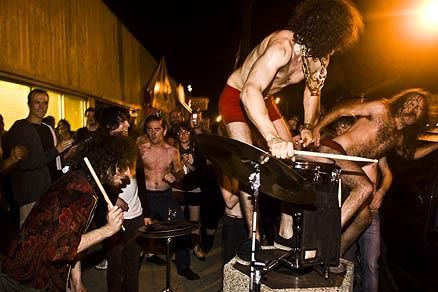
Montonix, is the premier rock band out of Israel that anyone has heard of. They are also the most insane live act touring the states (and boy did they tour last year, I think Rohan saw them like 6 or 7 times last year, I only caught them 3 times). Most of their shows generally involved emptied trash cans, fire, musicians standing on the bar, a drummer crowd-surfing while playing the drums, microphones places in genital areas, and often end with the whole band outside the venue. They are heavy on schtick, and while their music is amusing live, it's basically decent garage rock and nothing more. I probably wouldn't buy their album.

Vampire Weekend have a delightful debut album full of catchy songs. But they are a bunch of completely soulless Ivy League tools who dress like every day is a garden party (except at Pitchfork Fest when the drummer was wearing a Phish shirt). I hate their aesthetic, but the music is quite catchy, so I play the album from time to time.

Les Savy Fav is the complete package. Batshit crazy live shows (as Adam can confirm), for example the last time I saw them the singer ate my earplugs and wore my glasses. But beyond that they've release a number of utterly fantastic albums, and I've probably listened to Go Forth and Inches at least a hundred times each.

***

So back, to Ms. Gaga and her compatriot in obnoxious pop, Miss Katy Perry. I will grant Perry this, her songs are very catchy. They are hateful, homophobic and obnoxious (see "Your So Gay" and "Hot and Cold") and there's something really weird about her voice (besides the obvious studio touching up) but the songs are still very catchy. The rest of her images/lyrics/etc sucks and I'm repulsed by her in general, but the songs stick in my head. On the other hand "Poker Face" has to be the worst non-Black Eyed Peas pop song on the radio in years. And the schtick is super obnoxious, as I said in my comment. She ain't critiquing shit. She's a cog in the machine just like Perry and anyone else on a major label. To return to my mention of Lily Allen, when she says something on her blog or in her interview, I believe most of the time that she is at least saying something honest, if not something particularly intelligent. She is at least relatively tied to reality, which Gaga and Perry have departed long long ago.